
Case study
Granta
Designing a grant assistant for Hungarian SMEs
NDA project · real Hungarian banking client
Overview
A smarter way to access grants in Hungary
NDA
This project was developed with a real Hungarian banking client and is covered by a non-disclosure agreement. Some details, data and screens are simplified or left out to protect confidential information.
Hungary has around 900,000 registered small and medium-sized businesses, and there are EU and state grants designed to help them grow. Yet many owners never apply. Not because they don't qualify, but because finding, understanding and completing an application is simply too hard.
Granta is a multilingual digital assistant that matches business owners to the grants they actually qualify for, explains them in plain language, and guides them all the way to submission.
- ~900K
- registered SMEs in Hungary (KSH)
- 4
- key barriers between owners and grants
- 1
- assistant from discovery to submission
The process
Following the double diamond
We moved through the project in four phases: first going wide to understand the problem, narrowing it down to one clear challenge, then exploring solutions before refining one into a working product. The case study follows the same path.
01 · Discover
- Desktop research
- Grant landscape mapping
- Target audience
- Barrier synthesis
02 · Define
- Problem statement
- How might we…
- Design principles
- Project goal
03 · Develop
- Concept: Meet Granta
- User journey
- Matching logic
- Business case & flows
04 · Deliver
- Onboarding
- Main flow
- Re-engagement
- Freemium screens
Discover
Research & planning
We started wide. Before sketching a single screen, we wanted to understand how the Hungarian grant system works, who it is meant to serve, and why so much of the money never reaches them.
Research plan
Four steps from question to insight
- 01
Desktop research
EU and KSH data on SMEs and grant awareness, and how the Hungarian grant system works.
- 02
Grant landscape mapping
Programs like GINOP-PLUS and the Széchenyi Card Program, and providers such as the Hungarian Development Bank.
- 03
Audience mapping
Who Hungarian SME owners are: from local hospitality to manufacturing and independent services.
- 04
Synthesis
Clustering what we learned into the barriers that stop owners from applying.
The landscape
The money exists. The people it is meant for often never find it.
~900K
registered SMEs in Hungary
HospitalityRetailServicesManufacturing
Source: KSH, ksh.hu/business-units-and-non-profit-organisations
Low awareness
According to EU survey data, only around a third of European SMEs are aware of the public financial support available to them (Flash Eurobarometer 441, 2016).
Grants are announced in calls written for experts, spread across many portals and providers, and rarely reach the owner of a small café or workshop directly.

Who we are designing for
The full spectrum of Hungarian SME owners
From local hospitality to manufacturing and independent services. They are experts in their own business, not in Hungarian grant law, and they don't have time to become one.
What we found
Four barriers stand between owners and the money
Synthesis · the current journey
Where owners drop off today
Mapping the barriers onto the steps of applying showed the real pattern: every step adds friction, and the experience gets worse just when effort is highest.
Define
From many problems to one clear challenge
Looking at the four barriers together, we realised they were not four separate problems. They were one: the path from a business owner to the right grant is broken.
Problem statement
SME owners miss grants they already qualify for.
The money is there, but the path to it isn't: it is hidden, written in legal language, and broken into paperwork that nobody guides you through.
How might we…
Turning the problem into questions we could design for
HMW
…help owners find the grants they qualify for, without having to search?
HMW
…turn legal requirements into language anyone can follow?
HMW
…guide owners step by step from a match to a finished application?
Design principles
Four rules that guided every decision
01
Only show what fits
If a hard requirement fails, the grant disappears. A 0% match is misleading; absence from the list is cleaner.
02
Plain language first
Every requirement, deadline and amount explained without legal jargon, in the owner's own language.
03
Do the work for them
Build the eligibility profile from existing business data, so owners answer as few questions as possible.
04
Never a dead end
When a grant is not enough, connect owners to loans, guarantees and grant writers.
Help SME owners discover, understand and apply for the grants they qualify for, without needing an expert.
Develop
Exploring the solution
With a clear problem, we explored how a digital assistant could take owners from “I didn't know this existed” to a finished application, and why a bank would want to offer it.
The concept
Meet Granta
A multilingual digital assistant matching business owners to grants they qualify for, in their language, in plain terms.
- Easy to set upGuided onboarding and data synchronising
- Easy to understandPlain language instead of legal jargon
- Further help accessConnecting you to loans, guarantees and grant writers
User journey
How Granta works, in four steps
- 1
Profile setup
Owners answer plain-language questions. Granta builds their eligibility profile from their business data.
- 2
Grant matching
Only grants they qualify for are shown: translated, simplified, with deadlines and amounts up front.
- 3
Guided application
A step-by-step document checklist with plain explanations, and reminders for key deadlines.
- 4
Bank handoff
The bank's SME loans, guarantees and grant-writer services appear as the natural next step.
Grant matching logic
Two stages, so owners only see grants that truly fit
The core of the product is a rule system. We designed it so the interface could stay simple.
One question is always asked manually: “What do you want to use the funding for?” The investment goal can't be read from registry data, and it is what makes a match truly relevant.
Business case
Why this is a win-win
For Granta to exist, someone has to offer it. We framed it as a service a bank could provide to its SME clients.
User flow
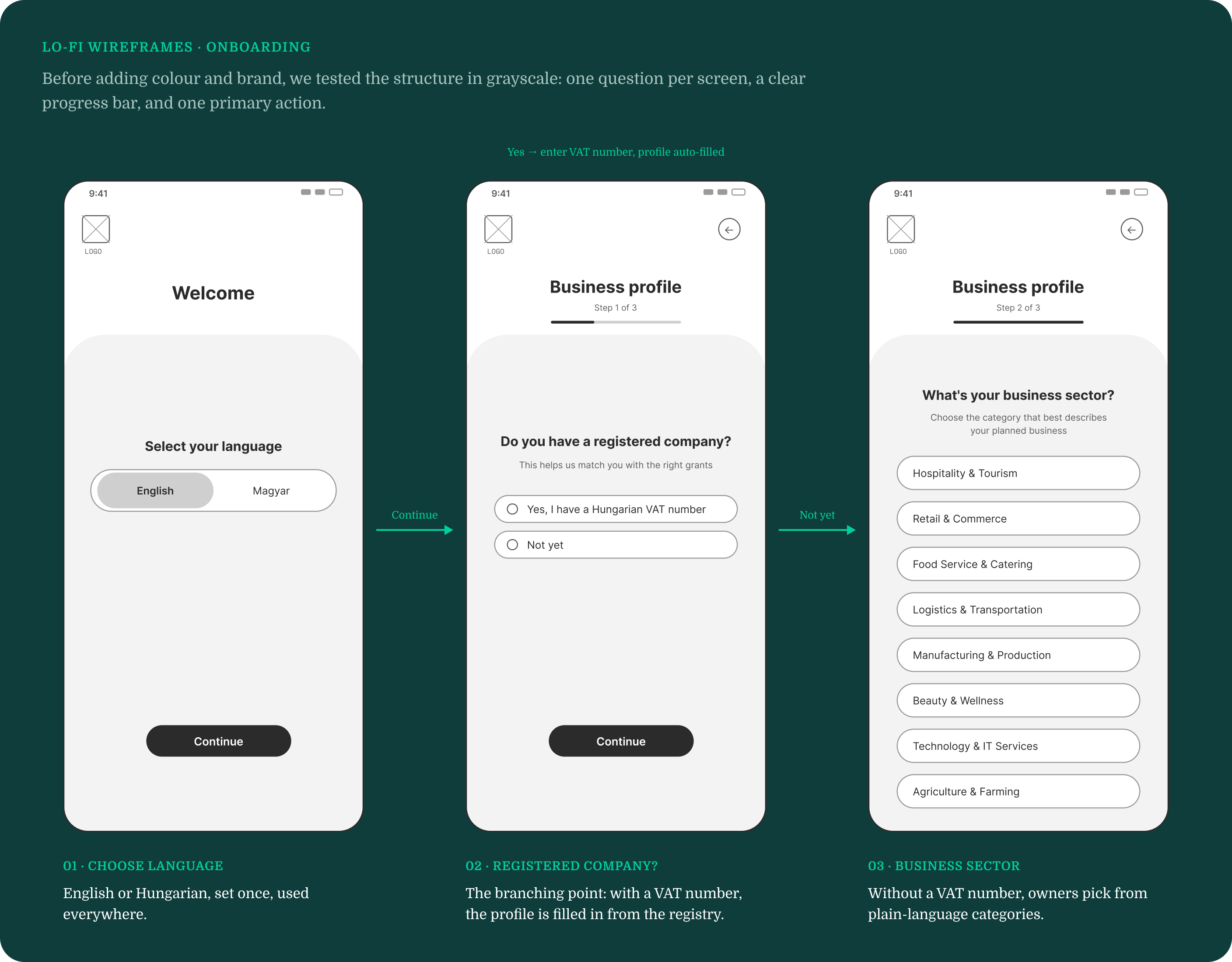
Two ways in: with or without a VAT number
Not every owner has their company data at hand or they haven’t started the business yet. We split onboarding so those with a VAT number get a profile filled in for them, while others answer a few plain questions.
Deliver
Designing the final product
We turned the rule system into a calm, guided mobile experience. Every screen follows the same visual rules: order and highlight information, so owners never have to decode what they see.
Visual language
Calm, trustworthy, and clear
Deep teal
#093030 · trust, calm, banking
Granta mint
#00D09E · action, growth, “yes”
White
#FFFFFF · space for content
Aa
Poppins & Inter
friendly, round, highly legible at small sizes
Two simple circles, one memorable mark
Onboarding
Two entry points, one simple start
With a VAT number, Granta pulls the company data and the owner only confirms it. Without one, a few plain-language questions build the same profile.
Main flow
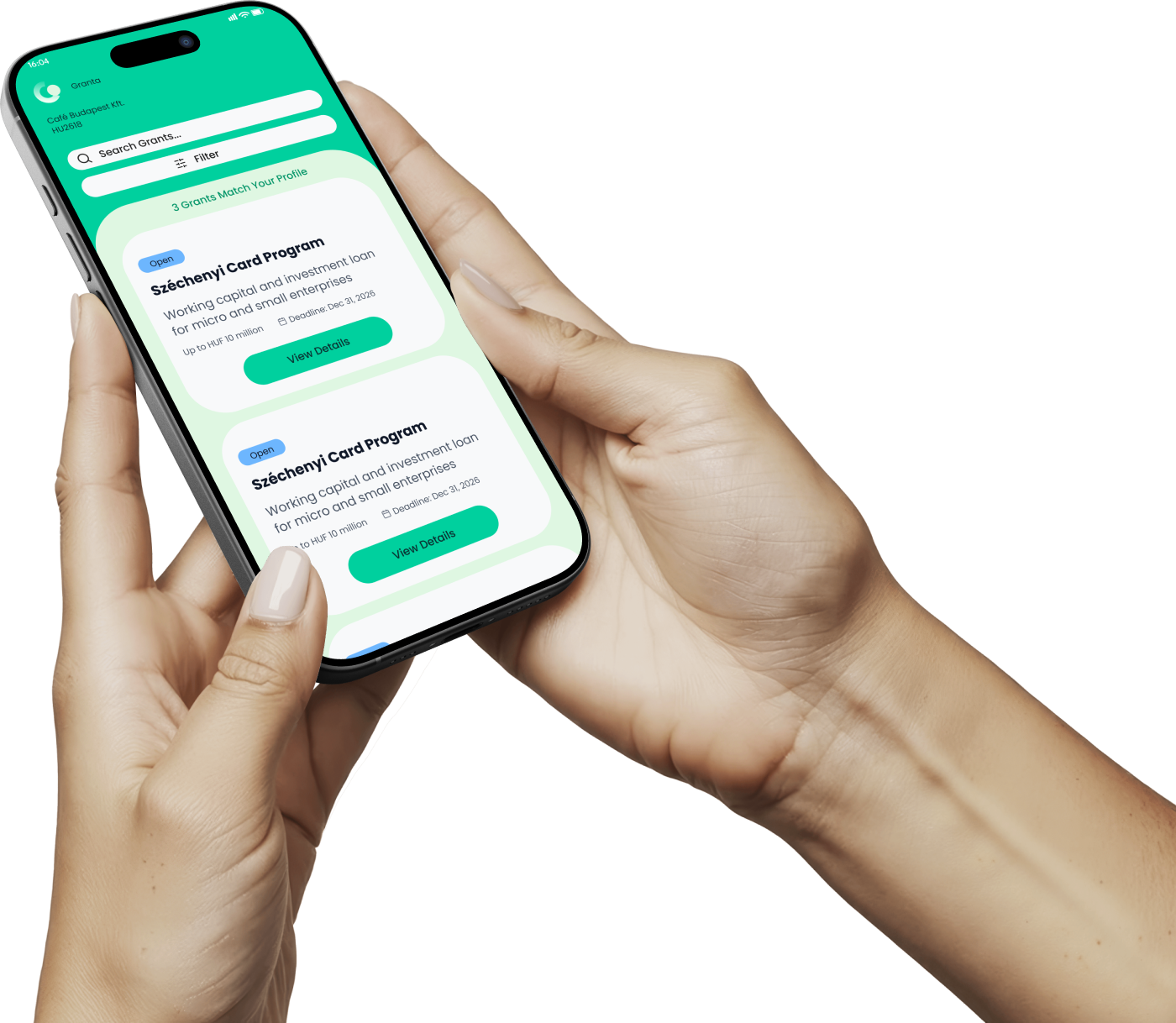
Only the grants that fit, explained in plain terms
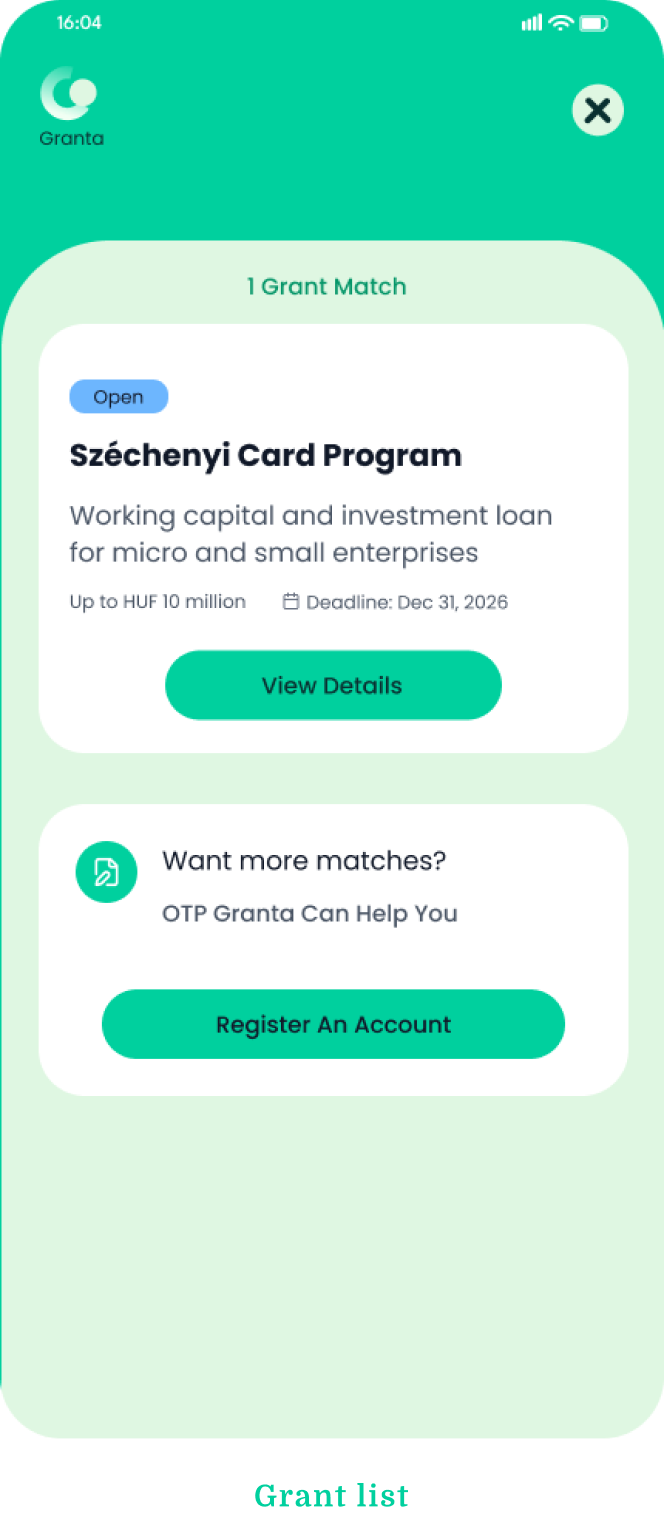
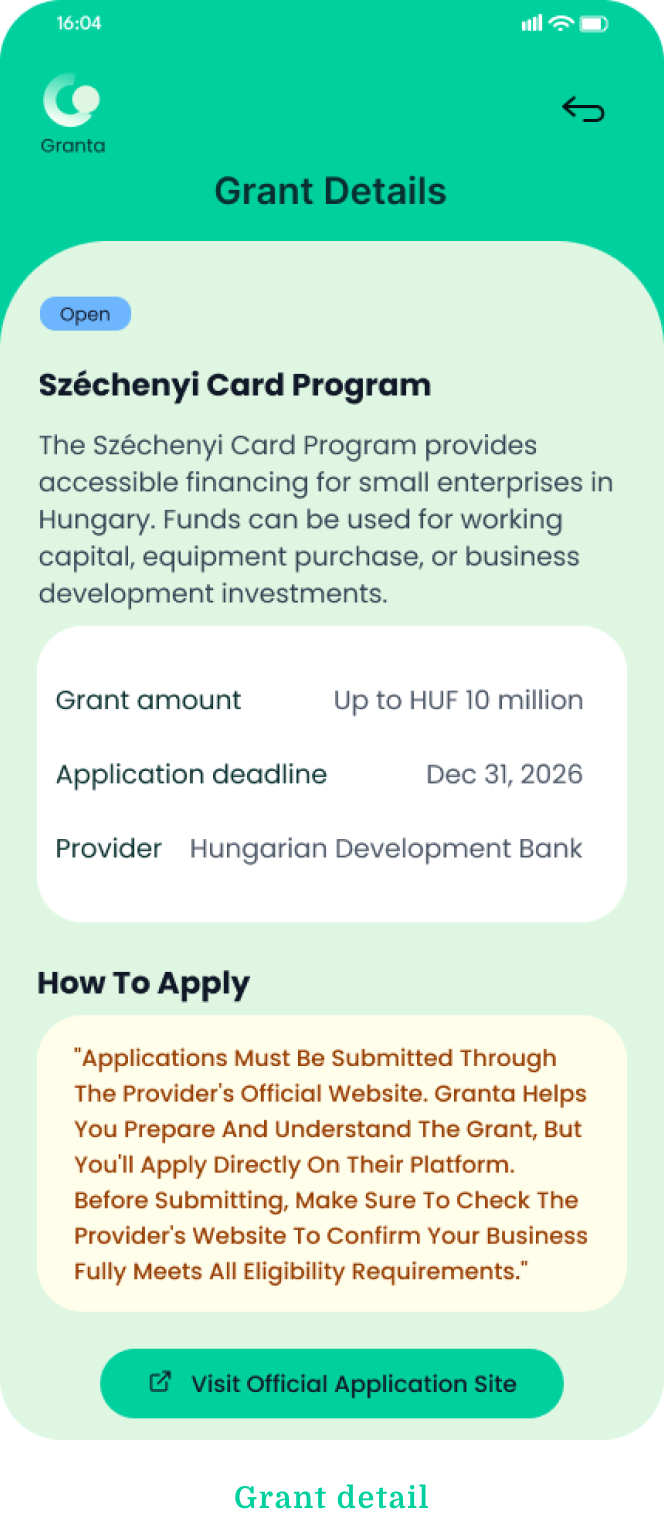
The home screen lists matching grants as cards. Each card answers the three questions owners care about first: what is it, how much, and by when.
Proximity
Grant name, provider, amount and deadline sit close together on each card, so they read as one unit of information.
Similarity
Every grant card shares the same structure and style, so owners can compare grants at a glance instead of reading each one.
Common region
Each card is its own container. The boundary separates one grant from the next, even in a long list.
Figure–ground
The mint call-to-action is the only saturated element on the card, so the next action is always obvious.
Re-engagement
Bringing owners back at the right moment
Grant applications take weeks. Granta follows up with timely, specific nudges: an approaching deadline, a missing document, or a check-in after the owner visited an application page.
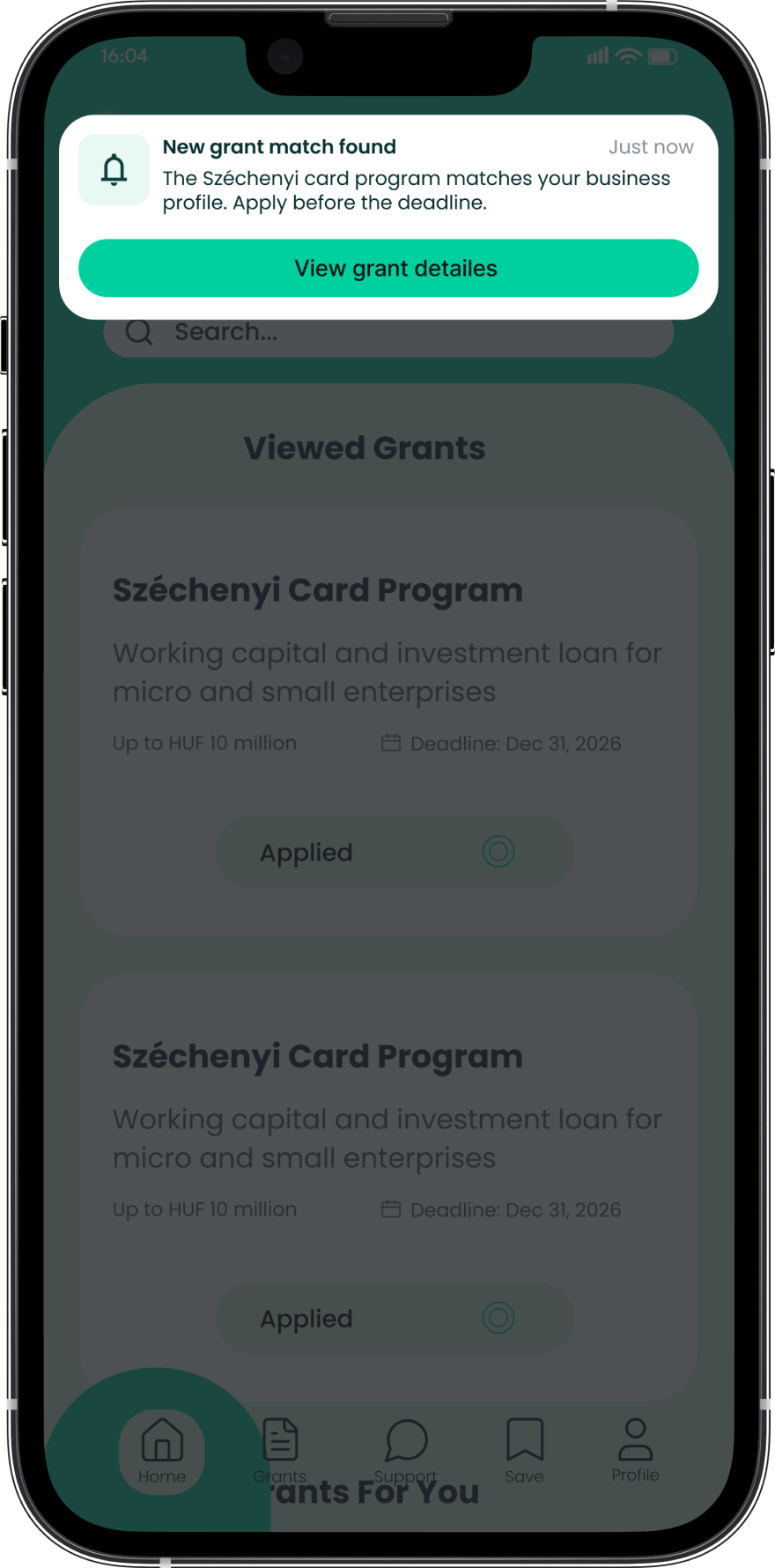
Grant applicationJust now
We noticed you visited the Széchenyi Card Program application page. Did you start the process?
Document requiredYesterday
Please upload your company registration certificate to proceed with your saved application.
Deadline approaching2 hrs ago
Your application for the GINOP-PLUS fund is due in 7 days. Make sure you uploaded every document.
Freemium
Try it free, grow with the bank
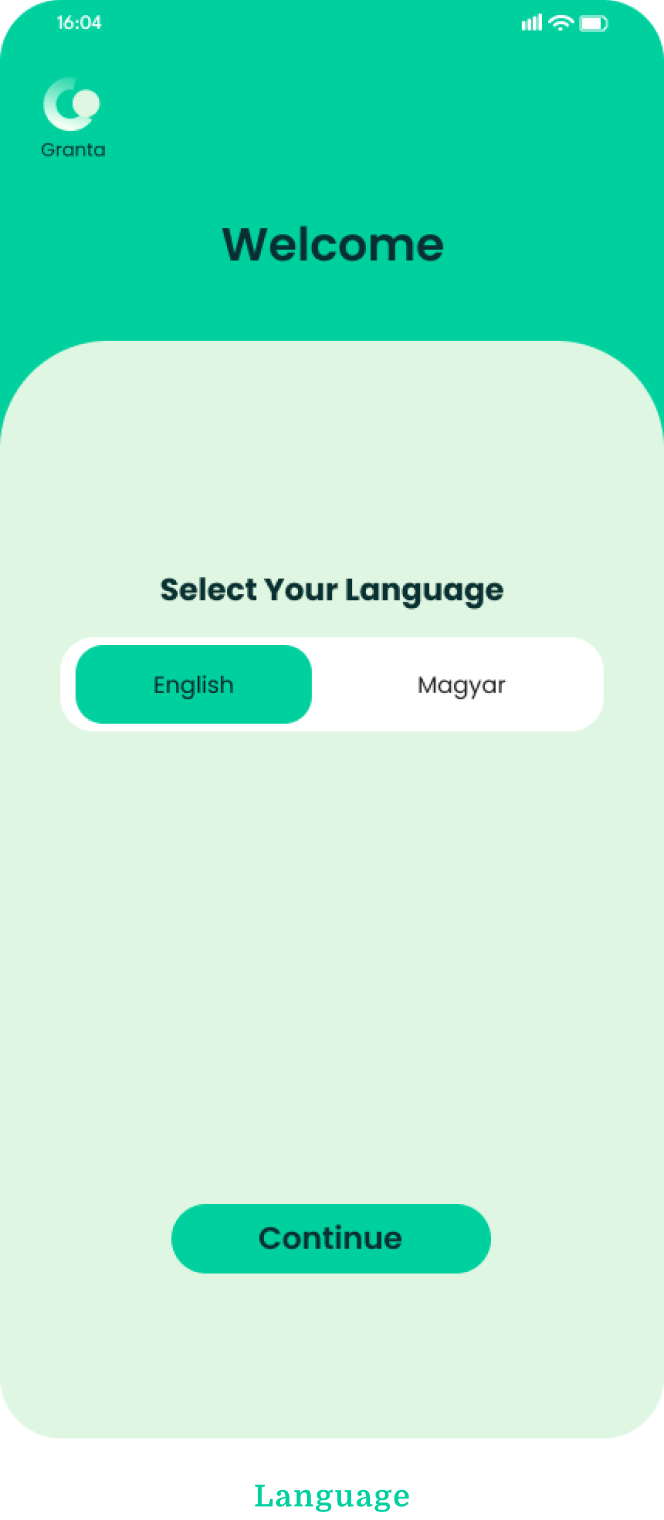
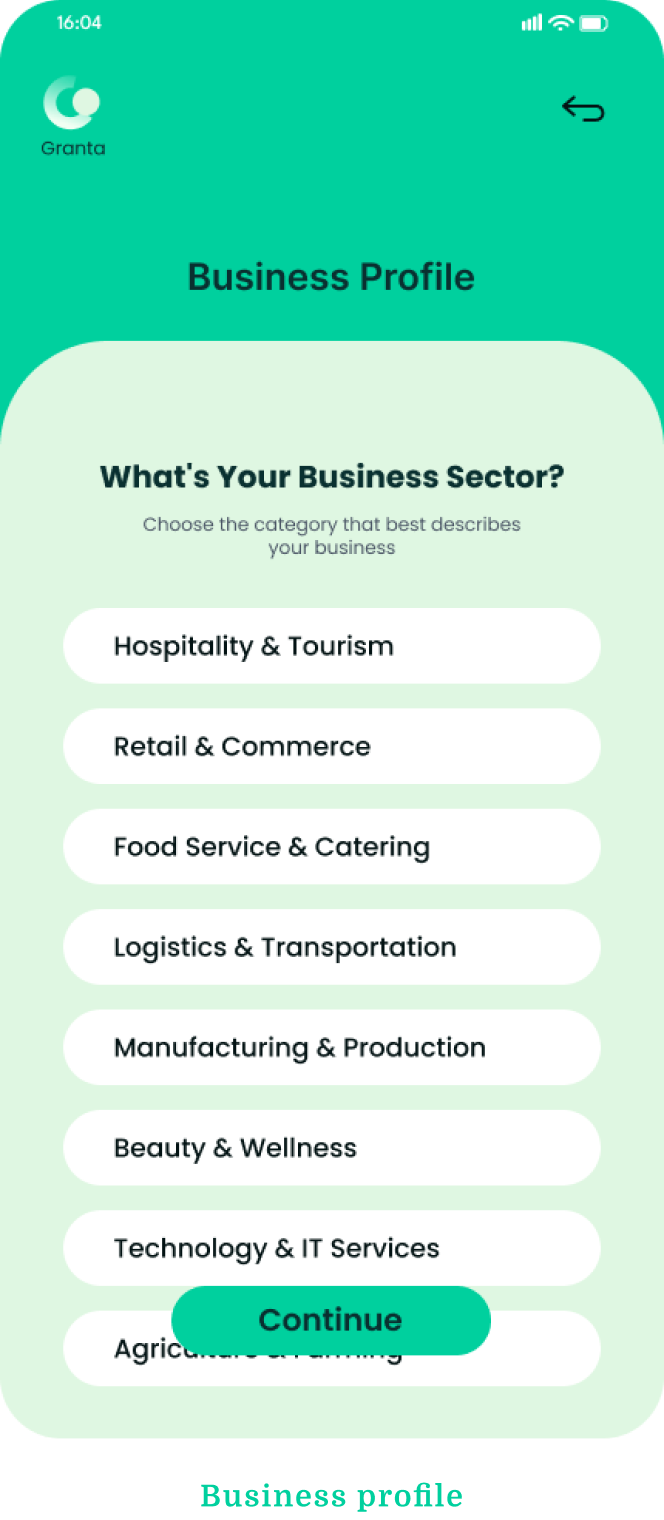
A free version lets any owner set their language, build a business profile and explore the grants they match. It is also how the bank meets new SME clients.
Testing & validation
What we learned from users
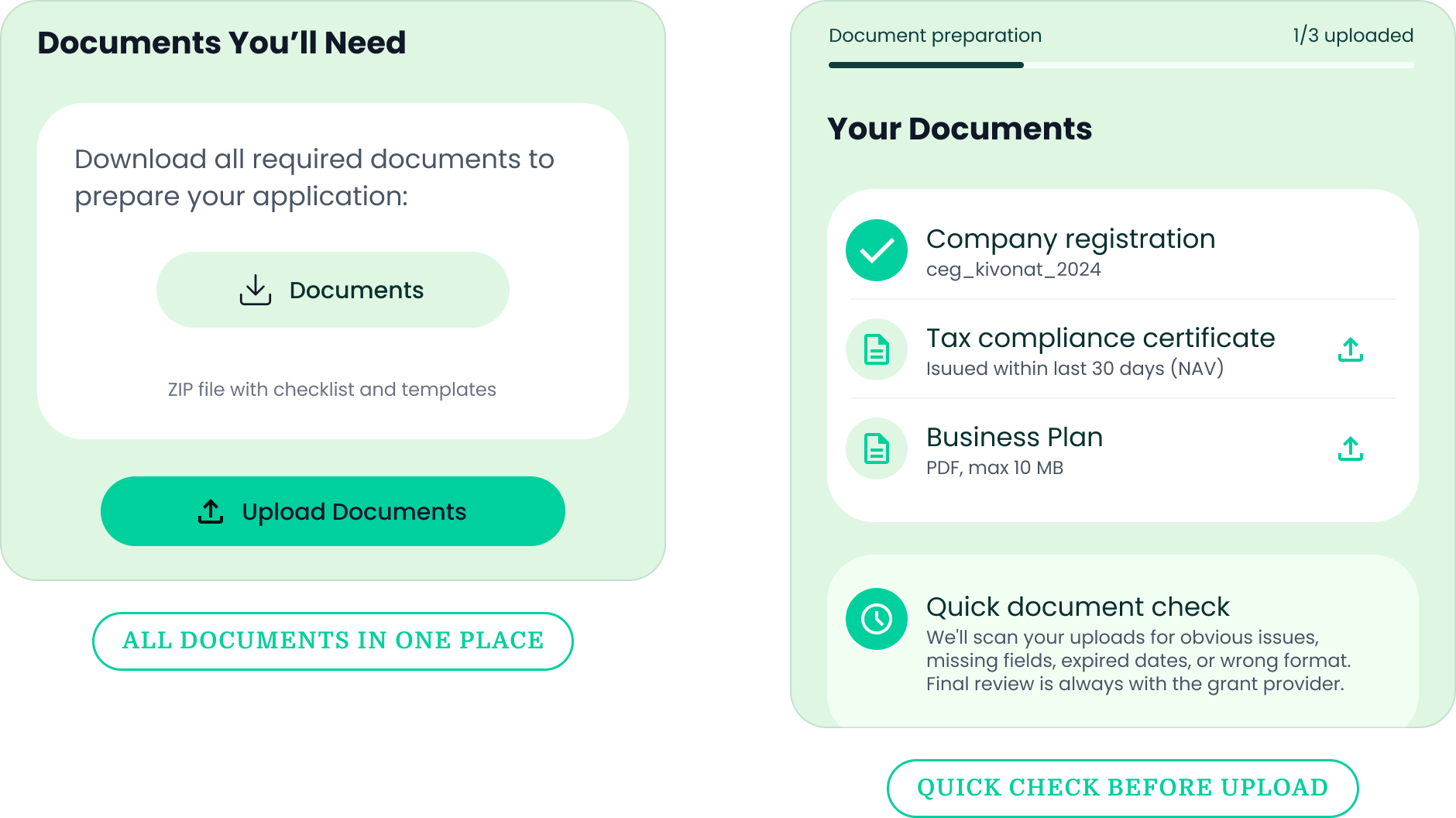
We did a first round of testing with 5 Hungarian SME owners. The findings confirmed that this application would help SME owners to navigate and apply to grants with more confidence, because of the clear and understandable language and the application guide. The participants noted that it would also be great if Granta could gather the needed empty documents in one place and check for “basic” errors (typos and missing information) before the user uploads them to the official application site.
We also tested it with the bank client, and the feedback was positive.
Reflection
What this project taught me
What I learned
- Designing the rules before the screens. The matching logic decided how simple the interface could be.
- Designing to simplify complex legal terms is not easy and it requires precision.
- Visual principles are a tool for clarity, not decoration. Gestalt helped us simplify dense, legal information.
Next steps
- Test the matching logic and the plain-language copy with real SME owners.
- Validate the bank handoff and freemium model with the bank.
- Add more languages and an accessibility review.
Granta · 2026